

How to Read a Spiritually Restorative Landscape

Updated: Jul 28
The Fractal Dimension of Stress Reduction
Imagine you have an hour to recover after a stressful week. Which of these four places would you choose? Vote below.
Which would you choose for stress reduction?
An exposed hill or mountain path
Open parkland with mature trees and distant views
A river, lake or coastline surrounded by vegetation
A narrow path through dense conifer forest
Please choose before reading on. There is no correct answer, although there are some interesting reasons why one landscape might appeal more than another.
Nature is not one kind of place
I doubt we think of nature as if it were a single type of environment – of course it's not. It might mean sitting beside a river, walking through a plantation, crossing open moorland, gardening, climbing a mountain or eating lunch beneath a tree in a city park. These places do not look or feel the same. They make different demands on our bodies, attention and imagination.
There is strong science that exposure to natural environments, generally, can reduce how stressed people report feeling and can also improve physiological measures associated with stress such as heart rate, blood pressure and stress hormones.
I expect you find that some kinds of landscapes restore you more than others but the science would say that choice 4, the pine forest, isn't at the top of the list.

The surprisingly mathematical landscape
A curious part of this story involves fractals. Specifically the Fractal Fluency Model and the concept of Fractal Dimension.
A fractal is a pattern that repeats, approximately, at different scales. A tree divides into branches, which divide into smaller branches and twigs. A river separates into tributaries. A coastline contains smaller bays, rocks and irregular edges within its larger shape.
Researchers can measure the visual complexity of these patterns using something called a fractal dimension. This is normally expressed on a scale between one and two, which sounds more perplexing than it needs to. Think of it like this.
Near one, the pattern is sparse and simple. Imagine an empty horizon, a single line or a largely open plain. See the first image above.
In the middle, the scene has variety but remains readable: scattered trees, branching shapes, broken edges and areas of open space. Images 2 and 3 in the poll.
Near two, the pattern becomes dense and fills much more of the view. There are fewer gaps and more visual information wherever you look.
Some research into fractal patterns suggests that people often respond well to moderate complexity, higher than 1, less than 2. These patterns are varied enough to hold our attention without requiring too much effort to process.

Pioneering research by physicist Dr. Richard Taylor at the University of Oregon shows that the human brain evolved to efficiently process natural environments, which significantly reduces physiological stress (the elephant is happy here). However, the human brain has a specific sweet spot for fractal complexity, and environments that fall outside this ideal zone – either by being too chaotic or too rigidly repetitive – do not yield the same restorative effects.
The findings are used to inspire urban designers and interior architects to devise environments that we find less stressful; designers use the maths to create biophilic architecture ... but, back to nature.
Landscape patterns that people rate as relaxing may not be the same ones they find most interesting or beautiful. We don't always need nature to be stress-reducing.
What makes a spiritually restorative landscape?
I live among large areas of Sitka spruce plantation. I like walking through them, but I notice what happens when the planting has been thinned, the path reaches a clearing or the view suddenly opens across the hills.

The dense forest has enclosure, atmosphere and its own personality – but it isn't relaxing – the science would say our brains were oversaturated. The opening gives me something else. My eyes can travel further. I can locate myself in the wider landscape.
Something psychological may be happening, but the experience is not only that. The wider view changes my attention. It makes room for perspective, connection and sometimes a sense of presence. I become more available to the place and to whatever the place might be showing me. In some places God speaks through nature, more consistently for people.
A spiritually restorative landscape is not simply one that makes us feel better. It might help us become more present, more receptive or more aware that we are part of something beyond ourselves and our immediate thoughts.
Why parks and gardens work so well

The savanna hypothesis proposes that humans have developed a preference for landscapes resembling the resource-rich grasslands in which early humans evolved: open ground, scattered trees, accessible water, shelter and long sightlines. (The ai cartoon above gets at the connection).
When you look at an environment within that 1.3 to 1.5 sweet spot, a phenomenon called fractal fluency occurs. Because the human visual system (including the paths our eyes track and the structure of our retinas) is itself fractal, the brain processes mid-range natural fractals with almost zero effort.
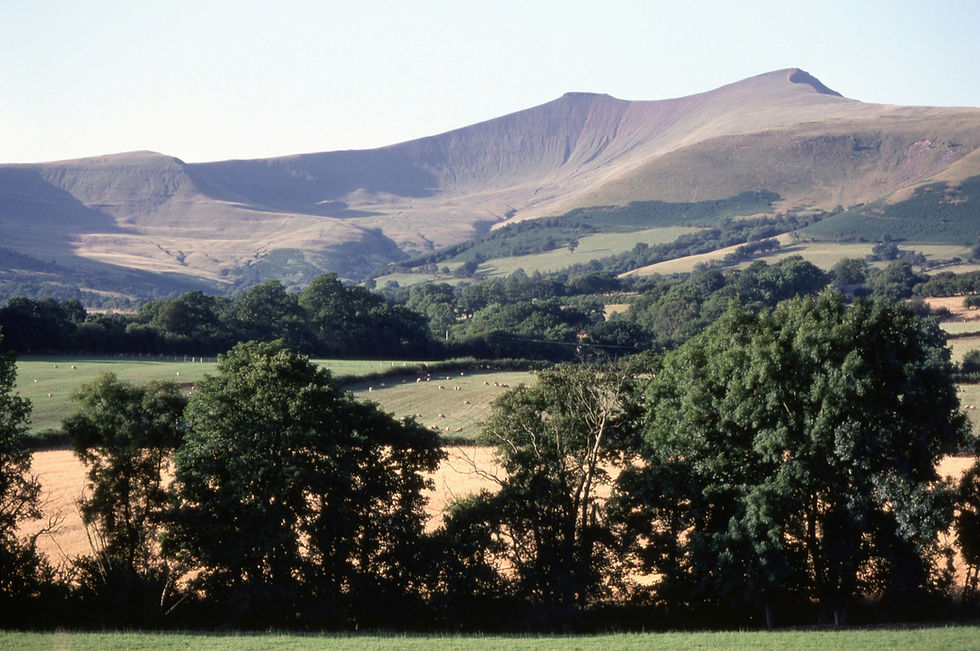
It is an attractive explanation for why parks and gardens end up looking like this and why it's comforting. A large tree beside an open field offers both shelter and prospect. The landscape is varied but relatively easy to understand. We can see ahead without feeling entirely exposed.
EEG studies show that looking at this specific level of fractal complexity causes the brain to instantly produce alpha brainwaves (the aha-moments brainwave). These waves are a signature of a relaxed yet deeply focused mental state – the exact neural mechanism behind why a walk in the right kind of woods reduces physiological stress levels so effectively and can also elicit creative insights.
For me the theory helps explain why the thinned pine plantation changes the experience so dramatically without adding anything new. (Sometimes restoration comes from what has been removed.)
Twice a week I run through the forest and I've seen this longer view countless times but I'm always open to it speaking to me as it did the day I took this photo:

The pull of blue-green places
It's worth making a special mention of blue-green spaces; places where water and vegetation meet: coastlines, riverbanks, wooded lakes, wetlands and estuaries.
Reviews of the evidence generally find a positive relationship between exposure to outdoor blue spaces and wellbeing, although there is still plenty to learn about which types of water environment are most helpful and why.
Water may gather several restorative qualities into one place. It opens a view, reflects light, creates repeated movement and provides a continuous field of natural sound. It also gives the landscape an obvious edge to follow.
There may be something spiritually significant about edges. Shores, riverbanks, clearings and hilltops place us between one thing and another. They allow us to see the world changing state: land becoming water, forest becoming sky, height becoming distance. What do you think? You can comment below.
The idea of thin places also comes to mind ... as does pilgrimage. A landscape does not need to be an established sacred site to become spiritually significant. Even a short local walk can become a micro pilgrimage when we enter it with intention.
The desired effect is not always relaxation
It would be a mistake to judge every landscape by how efficiently it lowers stress. Sometimes we want a path that is easy to follow and a view that asks very little of us. At other times, we need (or get) difficulty, weather, height and unfamiliarity.
An enclosed woodland might offer refuge, mystery or absorption. Open parkland might give ease and perspective. A river can support reflection and movement. A mountain may be physically demanding while offering challenge, flow, accomplishment or awe. And deserts ... let's not get into that just yet.
The same landscape can also meet us differently on different days. Exposure may feel liberating when we are restless and distinctly unhelpful when we are depleted. Enclosure may feel safe at one time and oppressive at another. Any landscape, and nature generally, isn't a static thing, it's always in process as I explored in my book Forest Church.
Spiritual restoration can include calm, but it can also involve becoming more awake, more focused, more humble or more aware that we belong to a world considerably larger than our current problem.

Learning to read a landscape
The next time you choose somewhere to walk, sit or spend an afternoon, try reading the place across a few simple ranges. Or better still, on a longer walk, when you notice in your mind, body or soul that the landscape is resonating with you, use these scales to read what's going on.
From open ↔ enclosed
Patterns simple ↔ intricate
Still ↔ moving
Sheltered ↔ exposed
Familiar ↔ unfamiliar
Easy to navigate ↔ demanding
Human shaped ↔ naturally shaped
Neither end of these ranges is inherently better. Notice what the combination does to your attention, your body and your sense of connection – your sense or ability to connect with God.
With some experience, you can ask: What kind of landscape do I need today?
Perhaps you need somewhere that allows you to exhale. Perhaps you need a wider view. Perhaps you need the concentration of navigating a woodland path, the perspective of a hill or the repeated movement of water.
You might also return regularly to one place. The nature-connection practice of using a sit spot allows you to notice how both the landscape and your response to it change over time. Learning to read a landscape is also a way of reading ourselves. The useful question is not which kind of nature is best, but what kind of attention or insight this place makes possible.
You might simply enjoy the place. You might use it for prayer, reflection or a practice such as Sensio Divina. You might discover that the place helps you notice something that has been difficult to see elsewhere.
If this is the kind of attention and conversation you are looking for, you can explore our spiritual directors here. Edit. Yes, I've noticed that we're bucking the trend – or is it just my photo choices?


Dear Bruce,
We have been enjoying your "Forest Church" book and see reference to the Wheel of the year 8-part calendar. Is this calendar still available in any form?
Many thanks.